The Football Federation of Cambodia (FFC) has launched an investigation into goalkeeper Vireak Dara following suspicions of match-fixing in the 1-2 loss to Singapore at the 2024 ASEAN Cup.
In the second-round match of Group A on Dec. 11, Dara made two questionable errors that led to both of Singapore’s goals within the first 16 minutes.
In the 9th minute, a back pass from a Cambodian defender caught the 21-year-old goalkeeper off guard, and he missed the ball, allowing Singapore’s Faris Ramli to finish easily into an open net. Just 7 minutes later, another back pass from a defender was mishandled by Dara, whose one-touch pass was intercepted by Shawal Anuar and this player slotted the ball in to make it 2-0.
Governments outside Southeast Asia have a fundamental role in tackling cyber-slavery in the region.
That is the wider lesson from the arrests in India earlier this month of three Indian men suspected of trafficking young Indian graduates to Cambodia, where they found themselves trapped as cyber-slaves. The arrests followed investigative reporting on the case from The News Minute in India.
As in many previous cases, the seven victims from Kerala in southern India were not told that they were going to Cambodia. They were misled into thinking they would be taking legitimate jobs in Thailand. Once in Bangkok, they were transferred across the border to their real destination.
The growing conflict between humans and water snakes in Cambodia’s Tonle Sap Lake – a vital ecosystem and the largest freshwater lake in South-East Asia – has reached a critical point, threatening the lake’s biodiversity.
The slithery water snakes are falling victim to bycatch and the rising commercial demand, from human consumption to feeding crocodiles, is slowly depleting the snakes in Tonle Sap, known for its rich marine ecosystem.
Marine conservationists say water snakes are critical to the lake’s biodiversity, serving as prey for predators, helping regulate aquatic species and providing resources for local communities.
Corrections to Cambodia’s real estate sector continued in the first eight months of this year with the value of approved property developments falling 29.1% from a year earlier to US$3.3 billion.
But “the approved industrial building area is trending upward and now accounts for the largest share”, the World Bank says in its annual Cambodia Economic Update released this month.
And “despite the overall downbeat investment, there has been a notable interest in investing in Sihanoukville”, it says.
Cambodian prosecutors have upgraded charges against a 40-year-old man to murder from attempted murder after he allegedly shot and killed a journalist in northern Siem Reap province while covering illegal logging in the area.
Si Loeuy is suspected of killing veteran Cambodian journalist Chhoeung Chheng, 63, who died of a gunshot wound on Dec. 7, two days after he was hit in the abdomen by a bullet fired from a home-made gun, while riding his motorbike near the Boeung Per Wildlife Sanctuary, in Chik Reang district.
Meas Chanpiseth, prosecutor of the Siem Reap Provincial Court, announced on Dec. 13 he would request an amendment to Si Loeuy’s charge to murder from attempted murder, which was originally made while Chhoeung Chheng was alive and undergoing surgery in a hospital.
The Mekong River is a vital source of support for the livelihoods, economies, and cultures of millions of people across six countries: China, Myanmar, Thailand, Laos, Cambodia, and Vietnam. It plays a crucial role in agriculture, fisheries and trade, making the sustainable management of the river a matter of utmost regional importance. However, the Mekong is facing increasing pressure from ambitious infrastructure projects, competing national interests, and the effects of climate change. One such project, Cambodia’s Funan Techo Canal, highlights these challenges.
Although the canal promises significant benefits for Cambodia, it has also sparked concerns about its potential environmental impact. These include the reduction of water flow, increased saltwater intrusion, and disruption of sediment transport, all of which could have severe consequences for Vietnam’s agricultural productivity and the ecological well-being of downstream regions. There are also concerns about the canal’s potential to shift the regional economic and geopolitical balance, as China is heavily involved in financing and constructing the project.
This article examines the concerns surrounding Mekong governance that have arisen with the Funan Techo Canal, focusing on the limitations of the Mekong River Commission (MRC) in managing transboundary disputes. It also explores the potential and challenges that may come with reforms aimed at strengthening the MRC’s governance mechanism.
Background
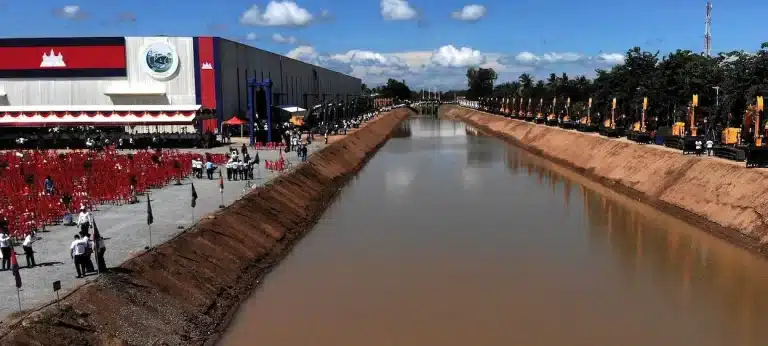
In early April 2024, Cambodia revealed its most ambitious infrastructure project yet—the Funan Techo Canal. Spanning 180 kilometres, this waterway aims to connect the Mekong River to Cambodia’s seaports, providing a direct transportation route from the capital city of Phnom Penh to the Gulf of Thailand. Being built at an estimated cost of US$1.7 billion, the canal seeks to lower transportation expenses and enhance economic connectivity by linking Phnom Penh to the deep-sea port in Sihanoukville. The Cambodian government predicts that the project will create jobs for five million people, which is almost one-third of the country’s population, across various industries.
The project is also expected to significantly increase Cambodia’s agricultural capacity. Currently, most farmers in the country can only grow rice crops one season per year due to the limited irrigation system. In contrast, Vietnam’s expansive dike and canal system has allowed its farmers in the Mekong Delta to cultivate two major cropping seasons most years. By providing sufficient water during the dry season, the canal is expected to enable at least two crop seasons per year for 300,000 hectares of crops in Kandal and Kampot provinces.
Currently, Cambodia relies on Vietnamese ports, particularly Cai Mep and Cat Lai, for transshipment of exported goods, providing a steady source of revenue for Vietnam. However, with the construction of the canal, Vietnam will lose this strategic advantage of having a critical chokepoint over its upstream neighbour.
Currently, Cambodia relies on Vietnamese ports, particularly Cai Mep and Cat Lai, for transshipment of exported goods, providing a steady source of revenue for Vietnam. However, with the construction of the canal, Vietnam will lose this strategic advantage of having a critical chokepoint over its upstream neighbour.
Technical Classification and Procedural Requirements
The classification of the Funan Techo Canal under the 1995 Mekong Agreement has sparked controversy. This Agreement had established the MRC, an intergovernmental organisation consisting of Cambodia, Laos, Thailand, and Vietnam, with the responsibility of managing the Mekong River’s water resources and promoting sustainable development. The MRC’s governance framework includes various mechanisms for water utilisation, such as the Procedures for Notification, Prior Consultation, and Agreement (PNPCA). This requires member countries to notify and consult with each other on projects that may have a significant impact on the river’s flow or ecosystem.
Article 5 of the Agreement distinguishes between intra-basin use and inter-basin diversion projects. Intra-basin projects involve the utilisation of water resources within the same river basin, while inter-basin diversion projects entail transferring water from one river basin to another. This could involve diverting water from the Mekong River to a dry region outside the basin to support agricultural development or provide urban water needs.
The usage of water is regulated through different procedures, depending on whether a project is planned on a tributary or the Mekong mainstream, and whether it affects water flow during the wet or dry seasons. Generally, tributary projects have fewer requirements as they have minimal impact on water flow, while inter-basin projects that use water during the dry season must go through more stringent procedures. Table 1 provides a summary of these key differences.
Table 1 – Procedures for Water Utilisation in Article 5 of the 1995 Mekong Agreement
Type of River
Season
Scope of water use
Required regulatory procedure
Tributary (Article 5A)
Both wet and dry season
Both inter and intra-basin
Notification Details of proposed project must be provided to other member states before commencing proposed use.
Mainstream (Article 5B)
Wet season
Intra-basin
Intra-basin
Prior consultation Six-month process for technical evaluation & formal consultations. Member states can assess any potential transboundary impact and recommend measures before water usage.
Dry season
Intra-basin
Inter-basin
Specific agreement Negotiation to achieve consensus among all member states on the terms and conditions of proposed project before water usage.
Dry season (surplus)
Inter-basin
Prior consultation(only if surplus water on Mekong during dry season is verified & unanimously confirmed by member states)
Source: Author’s compilation
Under this classification, the Funan Techo Canal is likely to be considered an inter-basin diversion project. This classification requires prior consultation, whether or not it has a significant impact on the dry season flow of the Mekong River. Furthermore, the canal will connect the Mekong mainstream, the Bassac Channel, and the Gulf of Thailand, which means that a specific agreement must be reached among member states under the 1995 Mekong Agreement.
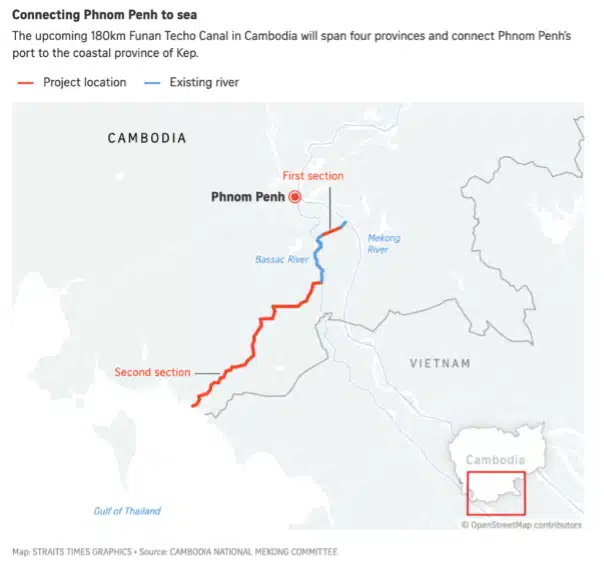
However, Cambodia has labelled the canal as a “tributary” project instead of a “mainstream” project. Their argument is that the Bassac Channel, which forms part of the canal, is a tributary. Therefore, Article 5A rather than 5B of the Mekong Agreement should apply. However, the hydrological connection of the canal to the Mekong mainstream, particularly its first section (refer to map below – Figure 1), suggests that it should be classified under Article 5B. Moreover, Cambodia’s classification of the Bassac as a tributary is inaccurate since it also carries mainstream water into the Mekong Delta. By definition, a tributary cannot carry mainstream water. Cambodia’s approach takes advantage of the lack of clear and distinct definitions for what qualifies as a tributary versus the mainstream within the Agreement, allowing it to avoid thorough scrutiny and potential objections.
Figure 1 – Full Extent of the Funan Techo Canal Once Completed
Source: Straits Times Graphics and Cambodia National Mekong Committee
The vagueness of the term “significant impact” within the Agreement further aids Cambodia’s position. Without a precise definition or specific threshold, member states can downplay their projects’ impact on the mainstream, thus categorising them as tributary projects. This can lead to inadequate assessment and mitigation measures. Furthermore, as the canal already began construction in August 2024, preliminary studies aimed at assessing the project’s environmental impact can no longer be done. Previous efforts to delay the canal’s construction based on its significant environmental impact have been unsuccessful, as these only rely on rough and potentially inaccurate estimations, not clear figures.
The principles of non-interference and consensus-based decision-making—the centrality of the MRC’s framework and ASEAN governance mechanisms—further complicate enforcement and compliance. These frameworks discourage member states from intervening in each other’s projects beyond the mechanisms established by the Mekong Agreement. As Laos, Cambodia, and Vietnam also maintain traditional “brotherhood” relationships with one another, preserving friendly diplomatic relations will take primacy over any environmental or hydrological concerns. As a result, despite having legitimate concerns over the canal’s impact, Vietnam is unlikely to openly challenge Cambodia.
Potential Avenues for Reform
Addressing these governance challenges requires several reforms. First, the MRC must enforce notification and consultation processes more strictly, with clearer definitions of crucial terms such as “significant impact” and unambiguous criteria for distinguishing tributary from mainstream projects. This will allow for more stringent requirements to be set for projects that affect the Mekong mainstream.
The current vague definition of a “tributary” hampers the MRC’s ability to regulate tributary projects, including those funded by the Asian Development Bank (ADB) or the Chinese private sector.
The division between tributaries and mainstream projects has incentivised member states to develop “tributary projects” within their territory, as these remain excluded from the 1995 Agreement. Closing these loopholes will require revising the Agreement, a difficult task as member states are keen to maintain full autonomy over development projects that support their economic growth.
Second, the MRC needs stronger enforcement mechanisms, including binding dispute resolution mechanisms and independent monitoring of project impacts. Past consultations, such as those concerning the Xayaburi and Don Sahong hydropower projects in Laos, could serve as models for establishing such mechanisms. However, the current mechanisms primarily rely on consultation, which limits their effectiveness in cases where member states have conflicting interests. Binding arbitration or adjudication processes, similar to those seen in other international river management agreements such as the Convention on the Protection of the Rhine, could offer a more structured and enforceable approach to dispute resolution.
Capacity reforms can also entail the MRC having a greater emphasis on joint impact assessments and playing a more active role in facilitating and raising funds for them. Member states could grant the MRC the capacity to actively seek opportunities for cooperation in assessments with other organisations and actors. One potential partner is the ADB, which supports development along the Mekong through its Greater Mekong Subregion (GMS) Economic Cooperation Programme. While the programme mainly focuses on infrastructure, its scope has also expanded to include policy fields that closely align with the MRC’s work, such as the Core Environment Programme. The GMS is attractive to riparian states due to the availability of funding, loans, grants, and co-financing from the ADB.24 As such, enhanced cooperation with the GMS will enable the MRC to secure additional resources, including the ability to recruit independent and reputable experts.
Reforms to the MRC’s governance mechanism can be guided by the UN Sustainable Development Goals (SDGs), particularly SDG 6.5, which focuses on the implementation of integrated water resources (IWRM) at all levels, including transboundary cooperation. In adopting more stringent IWRM practices and incorporating specific SDG indicators, the MRC will need to enhance its monitoring systems and establish clear, measurable goals. This will help ensure that riparian states are committed to balancing their economic needs with environmental sustainability.
ASEAN could also support MRC by ensuring that all member states share responsibility for the sustainable development of the Mekong basin. ASEAN could facilitate the integration of the MRC’s water governance initiatives into broader regional strategies for sustainable development. With support from the UN, ASEAN could also help bolster the MRC’s capacity through targeted technical assistance programmes, such as conducting comprehensive EIAs, improving data-sharing mechanisms, and implementing the latest water management technologies. The ASEAN Center for Sustainable Development Studies and Dialogue (ACSDSD) could promote cross-border learning and the transfer of best practices. An ambitious goal could be to integrate the MRC’s objectives into ASEAN’s broader agendas, such as the ASEAN Economic Community (AEC) and the ASEAN Socio-Cultural Community (ASSC), to ensure that water governance remains a key priority in regional development planning.
Challenges to Reform
Implementing these reforms will be no easy task. First, MRC member states are likely to resist changes that increase oversight and limit their ability to exploit the river’s resources. Both Laos and Cambodia place the Mekong at the centre of their current development strategies, and Vietnam has also utilised the Mekong’s waterways to become an agricultural powerhouse. As a result, riparian states may prefer the MRC to remain a relatively “toothless” organisation, allowing them to retain control over their development agendas. The 1995 Mekong Agreement has been criticised for being weak in enforcement, allowing states to interpret its provisions loosely or even disregard them at their convenience. Consequently, the MRC has focused on less contentious activities like data gathering and capacity building, which are essential but insufficient to address larger transboundary challenges. This institutional weakness is further compounded by the “Mekong Spirit”—a cooperative ethos among member states that has facilitated dialogue and reduced tensions, but also discouraged efforts to address difficult issues.
Cambodia may have come realise that it may be more beneficial to pursue its development projects independently, rather than relying on a regional framework that has repeatedly failed to safeguard its interests. This is evident in its unilateral decision to proceed with the construction of the Funan Techo Canal.
Second, efforts to reform the MRC risk destabilising the delicate consensus achieved by the 1995 Mekong Agreement. Member states may choose to withdraw rather than accept perceived unfavourable changes to the Agreement. As such, convincing member states to adopt stricter and binding agreements may prove difficult. Any move to strengthen the MRC must highlight the long-term benefits of a more robust organisation, particularly in terms of ensuring sustainable development and equity. Transparent and inclusive dialogue about the future of the MRC may help build the trust and political commitment needed for reforms, but this will be a slow and challenging process.
Addressing Cambodia’s Reliance on the Mekong
MRC reforms must account for the outsized role the Mekong River plays in Cambodia’s economic development and how Cambodia is particularly vulnerable to upstream developments compared to other riparian states. As 86 per cent of Cambodia’s territory is located within the Mekong River basin, and almost all of it consists of delta regions, the majority of Cambodians rely on the river’s resources and ecosystems, especially fish and fertile land. As a result, Cambodia has been the MRC’s most vocal advocate for many years, perceiving the Mekong’s development as having a more direct and serious impact on its wellbeing than that of other member states. However, Cambodia has grown increasingly frustrated with the MRC’s ineffectiveness in mitigating the transboundary impacts of upstream hydropower developments. Since the construction of Vietnam’s Yali Falls Dam in 2000, followed by numerous dams in Laos, this hydropower boom, combined with the effects of climate change, has caused record-low water levels and a decline in fish populations in the Tonle Sap Lake, which is not only Southeast Asia’s largest freshwater lake but also a crucial economic resource for Cambodia. In recent years, water levels have reached critically low levels, resulting in a significant decrease in freshwater fish catch volumes compared to previous years, with some years seeing a reduction of up to 50,000 tons.
Cambodia may have come realise that it may be more beneficial to pursue its development projects independently, rather than relying on a regional framework that has repeatedly failed to safeguard its interests. This is evident in its unilateral decision to proceed with the construction of the Funan Techo Canal. Much like other infrastructure initiatives backed by foreign investment, particularly from China, the canal signals Cambodia’s shift towards prioritising its economic development, even at the risk of further straining relations with its neighbours or the MRC.
Moving forward, any reforms to the MRC must address governance weaknesses, rebuild trust, and take into account member states’ attitudes towards Mekong development. While Cambodia has the right to embark on its development initiatives, this must be balanced with the sustainable and equitable management of the Mekong’s shared water resources to protect the interests of all riparian states, including Cambodia.
This is an adapted version of ISEAS Perspective 2024/92 published on 7 November 2024. The paper and its references can be accessed at this link.
Pham Vu Thieu Quang is an Editor at VietNamNet, a Hanoi-based news organization, and writes on international affairs and geopolitical developments in the Asia-Pacific.
This article was first published in Fulcrum, ISEAS – Yusof Ishak Institute’s website
The Foreign Affairs Ministry reported a sharp increase in Indonesians reporting to the Indonesian Embassy in Cambodia, with many falling victim to the growing online gambling industry. In 2023, the number of Indonesians voluntarily registering with the embassy surged by 638 percent, with most of the cases linked to online fraud and gambling.
“Based on self-report data at the Indonesian Embassy in Phnom Penh, 2,332 Indonesians reported in 2020. This number jumped to 17,212 in 2023,” said Judha Nugraha, Director of Indonesian Citizen Protection, during a press conference in Jakarta on Monday.
However, these figures do not reflect the actual number of Indonesians in Cambodia. Judha said local authorities have reported that 123,000 Indonesians entered the country by September 2024.
Days after a Reuters report suggested that China, as Cambodia’s “top creditor”, had stopped providing loans to the Kingdom, a senior official from the Ministry of Economy and Finance dismissed the claims as “misleading and ridiculous”.
A Reuters article published on December 11 noted that China did not approve any loans to Cambodia in 2024, citing third-quarter data from the Kingdom’s finance ministry.
The report speculated that China’s decision might be tied to “caution over failed infrastructure projects” in Cambodia. The article cited the Funan Techo Canal as an example. The outlet has previously alleged that the ambitious project has lost Chinese support.
A US warship docked in Cambodia on Monday (Dec 16), just kilometres away from a Chinese-renovated naval base, in the first American military port call to one of Beijing’s closest regional allies in eight years.
Washington’s relationship with Phnom Penh has been deteriorating for years, with China pouring billions of dollars into infrastructure investment under Cambodia’s former leader Hun Sen.
AFP reporters saw Cambodian navy personnel welcoming the USS Savannah’s arrival to the southern port city of Sihanoukville on Monday.
Cambodia and seven other governments recently launched a six-year $340-million project in Siem Reap to reduce the output of hazardous chemicals from the textile and construction industries.
The eight countries are members of the Global Environment Facility (GEF), an international grouping formed to provide money and technical support to combat major environmental challenges.
The $340 million in funding comprises $45 million from Cambodia and the other GEF countries and $295 million from international agencies and environmental organisations.
A U.S. Navy warship will make a port call next week in Cambodia, China’s close ally in Southeast Asia, the first such visit in eight years, according to a Cambodian statement on Friday.
Cambodia’s Ministry of National Defense said USS Savannah will dock at the port of Sihanoukville on the Gulf of Thailand on Dec. 16-20. Savannah, classed as a Littoral Combat Ship, carries a crew of 103, the ministry said.
The visit was scheduled after a U.S. request for a port call, it added, and would “strengthen and expand the bonds of friendship as well as promote bilateral cooperation” between the two nations.
The arrival of Cambodian police officers should have come as a relief for Abdureqip Rahman. The young Uyghur man had been trapped inside a high-walled, barbed-wire compound for 10 weeks, working alongside others trafficked here and forced, often through beatings, to run online scams.
But Rahman had become increasingly nervous at the prospect of rescue, wary of the Cambodian authorities. He had heard that the officers were there to take him to the capital, Phnom Penh, and then to immigration authorities who would send him home — to China, where the consequences would be “unimaginable,” he said.
Rahman tried to stay calm. He reminded himself of assurances from U.N. officials that he would be protected. He was hoping ultimately to secure asylum in the United States.
The bumper catch in the Mekong River Basin has boosted hopes of a revival of the critically endangered species, which is among the world’s largest freshwater fish.
Fishermen released the fish alongside officials from Cambodia’s Fisheries Administration (CFA), smiling as they held up the animals — weighing up to 130 kilograms (287 pounds) each.
China has not approved any loans to Cambodia this year, Cambodian finance ministry data for the first three quarters of 2024 shows, even though it has been Cambodia’s top creditor country in recent years.
The collapse in funding may signal China’s more cautious approach to investment in Cambodia after a series of so-far unsuccessful infrastructure projects in the Southeast Asian country.
China accounts for more than a third of the country’s $11.6 billion debt stock, Cambodian government data shows.
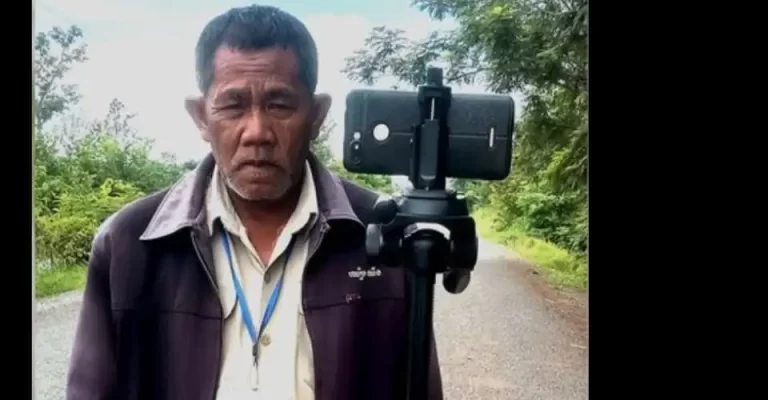
Chhoeung Chheng, a journalist covering environmental issues for local online news outlet Kampuchea Aphiwat News, has died of his injuries after being shot in Siem Reap province on Dec. 4 by a suspected illegal logger.
Chheng was rushed to a commune health clinic with a gunshot wound to the abdomen before being transferred to Siem Reap Provincial Hospital where, in the early hours of Dec. 7, he died of his wounds.
The attack took place at around 6 p.m. near Trapeang Phluoh village, Pongro Leu commune, Chi Kraeng district, Siem Reap province, close to Beng Per Wildlife Sanctuary, where Chheng and a colleague, Moeun Ny, had been traveling at the time.
A biodiversity survey carried out in the Samlout Multiple Use Area in Cambodia’s Cardamom Mountains has revealed an extraordinarily rich variety of invertebrates, reptiles, amphibians, birds and mammals, along with newly identified plant species.
The survey, led by Fauna & Flora, confirmed the presence of several threatened species, including Sunda pangolin, Asian elephant and dhole (a species of wild dog).
“This survey’s findings underscore the rich biodiversity within Samlout, a vital component of Cambodia’s protected area network,” says Pablo Sinovas, Cambodia Country Director of Fauna & Flora.
Ten members of the Cambodian environmentalist group Mother Nature were sentenced to six to eight years in prison for supposedly plotting against the government and insulting the King, but this has only emboldened the youth activists to reaffirm their commitment to fight for environmental justice.
Mother Nature is led by young Cambodians opposing mega-development projects that threaten to displace villagers and destroy the surrounding environment. Some of their campaigns include a video project raising awareness about river water pollution as a result of inadequate waste removal from factories, protests against illegal sand smuggling, and their documentation of sewage pollution near the royal palace.
The activists were previously arrested in 2020 because of their activism and were held in prison for 14 months. The July sentence is related to peaceful protests conducted in 2020 and 2021, as well as reports critical of the government.
China’s handover of a naval base in Cambodia to Phnom Penh early next year following a revamp is symbolic of the “slow erosion” of US geopolitical dominance in Southeast Asia, according to analysts.
The timeline for the Ream Naval Base’s redevelopment was confirmed by Abdul Rahman Yaacob, a research fellow at the Lowy Institute’s Southeast Asia programme, who shared the details with This Week in Asia after speaking to Cambodian officials.
The base in Sihanoukville province was originally scheduled to have been handed over in September this year, according to a report by Radio Free Asia in August.
Cambodia’s relations with the US have seen peaks and valleys. But they reached their lowest point when Donald Trump was president: the US halted aid to Cambodia citing democracy concerns in 2018 and Cambodia’s Generalised System of Preferences (GSP) status lapsed in 2020. Now, Trump’s return to the White House and his hard stance against China could put Cambodia in a more difficult situation.
A Cambodian journalist has died of a bullet wound after being shot while covering illegal logging in this country’s remote northwest, sparking an outcry among press freedom groups, though authorities were quick to blame the murder on a personal dispute.
Chhoeung Chheng worked for the online publication Kampuchea Aphivath, also known as the Cambodia Development News. His editor, Run Sareth, told The Diplomat that the alleged assailant was a “known illegal logger” and pulled the trigger after “he became angry.”
Police and authorities in Siem Reap province said Chhoeung Chheng, 63, was shot in the abdomen with a homemade gun around 6 p.m. on December 4, while riding a motorbike near Boeung Per Wildlife Sanctuary. Doctors removed a bullet but he succumbed to his wounds at 2 a.m. on December 7.