
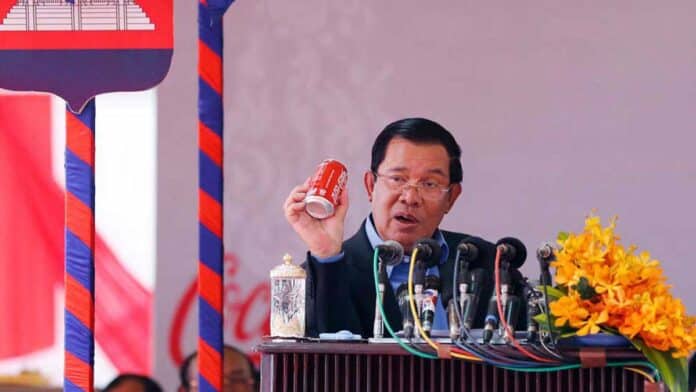
Cambodia’s ruling party leader, Hun Sen, has warned that Thailand is pushing Cambodia into conflict with the United States in diplomacy, trade, and investment if American companies, such as Coca-Cola, withdraw from the country.
Speaking on the evening of August 18, the Senate president called on Cambodians to remember that Coca-Cola is both an American and a Cambodian product because it is manufactured locally, providing jobs and revenue for Cambodian workers. Hun Sen emphasized that the company has consistently paid taxes to Cambodia, thereby contributing to the country’s national economic growth.
He urged the public to remain vigilant, saying Thailand has long sought to exert economic pressure on Cambodia through threats to cut electricity, suspend internet connections, or halt fuel supplies. Hun Sen said Cambodians must not fall into what he described as the traps of an adversary.
The warning follows an announcement by Prime Minister Hun Manet earlier this month halting purchases of strategic products such as electricity and fuel from Thailand after internet connections along the border were severed. Thai authorities said the blackout was part of a crackdown on cross-border online fraud networks operating in Trat, Koh Kong, Banteay Meanchey, Pailin, and Svay Rieng provinces. The crackdown has been linked to Cambodian tycoons Kork An and Ly Yong Phat, both major financiers of the Cambodian People’s Party and the Hun family.
Hun Sen told supporters they should understand why Coca-Cola ended its contract with popular Cambodian rapper Mann Vannda, stressing it should not be seen as a matter of national loyalty. He said Cambodians should not be misled into believing otherwise, pointing out that even Thai companies investing in Cambodia are protected by the government because their operations benefit the country.
He said if Coca-Cola products were made in Thailand, Cambodians could choose to boycott them. But because the drinks are produced inside Cambodia, a domestic boycott would only harm Cambodian workers, the wider population, and state revenue.
On August 17, Facebook users began calling for a boycott in support of Mann Vannda after Coca-Cola terminated his contract and removed his image from its billboards. Some reports linked the decision to his criticism of the Thai government and military for incursions into Cambodian territory.
However, Thai newspaper The Nation reported that Coca-Cola ended the partnership after determining that Mann Vannda had breached a key clause in his contract by making political comments. The paper said the company’s global policy requires its brand ambassadors to maintain a positive public image and avoid controversy.
Former Minister of Industry and Handicrafts Cham Prasidh said in 2016 that Coca-Cola first invested in Cambodia in 1993 with ten million US dollars. By the end of 2016, the company had built a major factory in Phnom Penh Special Economic Zone on more than 12 hectares of land with an investment of 100 million US dollars, employing more than 800 Cambodians.
The latest dispute highlights how commercial decisions by multinational corporations can quickly take on political significance in Cambodia’s tense relationship with Thailand, while also raising questions about the limits placed on public figures who endorse global brands.